Showing posts with label Hig Higman. Show all posts

Monday, April 30, 2012

Apple's Lion and TOPO!

Getting a new operating system on my Mac often freshens the experience so much that I feel like I have a new computer. That's certainly been the case with OS X 10.7.3, Apple's Lion operating system. It has many new features, especially in the browser and the interface with the swipe pad, that really feel new.

In fact, it seems that new OS on old hardware could be the model for future economic growth without resource consumption. For example, imagine in the future if we could keep our old car and yet when we have the cash upload a new "look". That way status-conscious could upgrade their status, yet the new look would just be software -- now that's sustainable growth. The growth is people buying and consuming (i.e., the 20th century economic engine model) but what they buy is not extracted from the Earth, but rather from people's imaginations, which seems like a sustainable resource.

Anyway, that digression aside and back to reality, Apple's Lion operating system and TOPO! aren't yet compatible so I have been forced to look at Google Earth alone for Alaska trip planning.

Which brought up an old email from Hig:


Hi All,
 I was talking with a GIS geek this week and he mentioned that you can get
 a feed of all the Alaska topo maps for Google Earth:
 > http://kml.gina.alaska.edu/
 (There's some other cool stuff here too.)  If you zoom in, it will give you progressively more detailed maps, right down to the 1:63k.
  It's a bit sluggish, but otherwise it's a pretty incredible and free tool
 for exploring Alaska.  Maybe you all know about this already and I'm just
 out of the loop, but it's not exactly an easy thing to find, so I thought maybe
 not.
 -Hig

Wednesday, January 25, 2012

Yakutat to Glacier Bay: Lost Coast South


Last summer a bunch of us got an email from MC saying he had a packraft and wanted to match it with his fat bike. Wasting no time, I pitched the route I'd bought a 907 for: Yakutat to Glacier Bay, the Lost Coast South, a route Dick Griffith did in the 90s and told me was the "best trip in Alaska."

Well, I have heard that about a lot of routes, and claimed that for a handful of my own, too, so while I considered it, I never attempted it. Mostly because I was unsure of what ocean water packrafting would be like. I hated lake paddling in the old stubby boats (pre-2011), I knew, and so thought that the ocean was just like a freekin huge lake. Nope.

What Hig and Erin pioneered was packrafting biggish crossings. Dick had used an airplane to hop over Lituya Bay and had flown in to the start, down by Icy Point. After the peripatetic couple gushed about it on blog, book and lecture, I wanted to do it even more, going so far as to scheme and join Skurka on his trip, but instead settled for the Wrangells with him in May 2010.

As for what part of the Lost Coast appealed most, going south was better than re-creating the Eric/Dylan bike route north, as the north route (now something of a backcountry bikenraft "trade route: with this pair and this Italian soloist repeating it) looked challenging but not that appealing nor wild. Heck, there are logging roads and lodges and lots of non-wilderness between Yakutat and Cordova, dissuading me from that route.

Plus by going south Eric (gear maven) and Dylan would want to go, too, as their trip sounded punishing and I was sure they'd like to "complete" the Lost Coast.

The southern Lost Coast looked burlier, wilder, prettier, more mountainous -- my kind of route. And if risk-averse Andy could do it solo, then certainly we could do it with bikes.

"World Class bear trails" had been noted by all, too.

With beta from Skurka and Hig providing comments like "A bike?" and "La Perouse? Yea, just walked on by!" and even both of them saying their route over to Brady Glacier/Taylor Bay from the outer coast was "bad", I felt prepared.

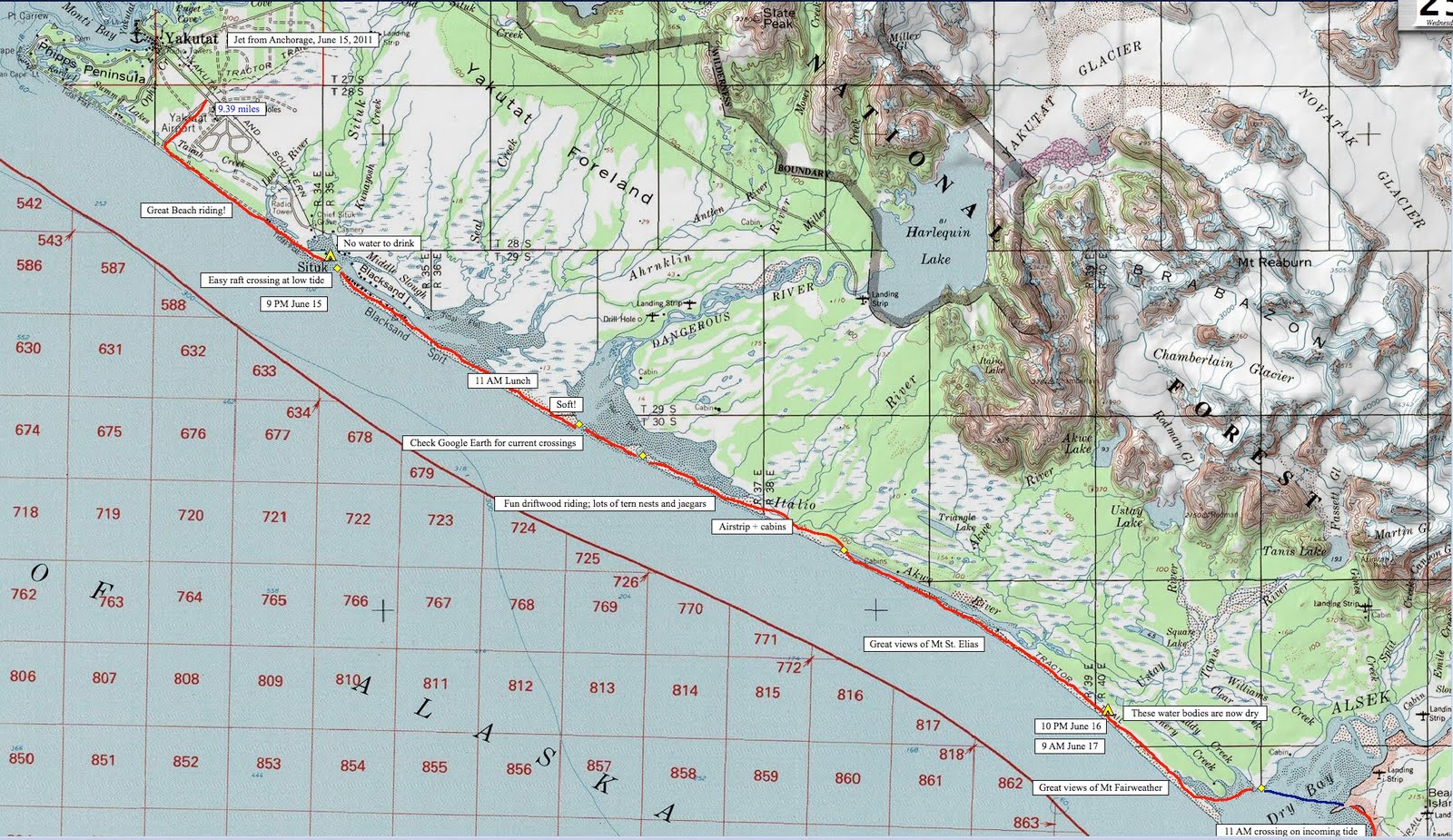
Looking at the map and Google Earth, it was clear that the route fell into roughly three pieces that reflected the fraction of pedaling that would be available.

The first piece to just south of Dry Bay and north of the creek to the Grand Plateau Glacier looked like a long beach ride, punctuated with some boat crossings.

The second piece looked like about half pedaling, half pushing/carrying past glaciers and rocky points, ending down a bit south of Icy Point.

The third piece looked like pushing and paddling and Eric and I had different ideas about how to get over to Taylor Bay and MC and I different ideas about how to get to Icy Straight.

Earlier, I posted some stats about the route and Eric posted pics and MC a nearly viral video.

In general, the first half is dry.

For some dumb reason, neither of our first camps had drinking water.

The riding nears boring, but has some super cool driftwood and dune sections, and you'll want more than one gear. I had two and liked them both. The views of St Elias to the north and Fairweather to the south are great as long as the weather is nice. If the weather were bad, I am thinking you'd have headwinds and rain.

Dry Bay would be a great destination, if you wanted a short, less committing trip. Even as an out and back.

We got off the plane, packed our bikes, ate dinner and road to the beach, then pedaled to the Situk and camped. We boated across Situk River in the morning and made it to a couple hours shy of the Alsek. We crossed the Alsek as the tide came in and it was easy. We had coffee on the south bank. My point is the down an back could be, like, a three day trip.


The good beach continues down to the big boulders just before the northern outlet of the Grand Plateau Lake. Bear trails take you to the put-in at the lake where we found a note from Gordy and Thai. A funny note, about how silly we were to be riding bikes. It was on a Lindt chocolate wrapper. It was a delight.

We paddled the entire length of the lake -- first half in the twilight looking for a beach to camp on and finding one that was scary when a mini-tsunami followed a five minute calving event. Doom slept on his boat that night.

The next day we paddled through amazing icebergs to the far end of the lake and then stumbled through bad Class IV brush with devils club, raspberry, nettles, and a giant curious bear that about got Doom pooping his pants when he bumped into it in the thick forest and it huffed at him.

Great beach riding starting on sand, increasing to gravel, then on to cobbles, and finally boulders leads to the spectacular Cape Fairweather. Here we alternated between shoving bikes down bear tubes on the wooded bluffs or stumbling and lifting loaded bikes over big boulders on the "beach".


Beyond we had great riding with remarkably constant beach backed by uniform forest. See Eric's clip here. We pedaled onward at the amazing 6-7 mph (we had a tailwind -- generally we get 4-5 mph and sometimes only 3 mph in soft sand) and camped at pretty Eagle Creek, a few miles north of Lituya Bay.

Thankfully the notorious Lituya was easy and calm but I was nervous in my wee Scout and steep but short swells as we poked out into the bay. Near the far shore a wicked fast current whipped us out toward the mouth and I ferried like I was in a river to get out before going too far. More pushing on stubby bear trails past a fantastic sea lion haul out led to more riding. But again, the pushing was very bad before the good riding, very BAD (not like the photo below).


Unlike the mountain hellbike trips of the nineties, this beach riding offers a less frequent split of riding vs pushing/carrying. Here on the Coast it's like, OK, two hours riding followed by two hours stumble-f*cking. Hellbiking was more like 5 minutes riding, 2 minutes pushing, 3 minutes riding, 7 minutes pushing. I exaggerate, but both seem to be about 50% non-riding to 50% riding but in different scales of time. On the coast it can be an entire day of riding, followed by an entire day of boating, followed by an entire day of pushing. This was new for me.

As we headed south the coast became rockier, not with boulders so much as with bedrock, rideable, challenging bedrock. There were some tough creek crossings, pinned between whitewater and surf, through rounded, polished boulders slick with green algae. Check the video below for some of that nasty action. Watching me with my bike over my head terrified the others. But watching them man-handle their frame-bag loaded bikes -- at one point Parsons just dropped his bike and watched it float nearly out to sea -- convinced me that over the head was far more stable.


We camped in view of La Perouse, an enormous surging glacier that had poked its brown head out into the Pacific, not fully, but enough to block the easy walk that Hig and Skurka had encountered. In fact, just a week earlier Thai and Gordy snuck by scrambling on boulders of ice, but we found the ice calving into surf, even at low tide.

Still, I pushed us into a dangerous situation, below calving ice and calf deep in surf that surged past ice blocks and boulders. When we turned a corner after an open area of easy walking, only to see massive cliffs shoved into surf, it was clearly time to retreat and sort out other options.

At one point on the way back a massive chunk of ice collapsed with in thirty feet of Doom, a terrifying moment that got us all running.

Dylan and I liked the idea of going over the glacier as opposed to Eric's idea of a surf launch. My boat was just too tiny to hop in easily with its fat bike cargo and narrow little slit through a mylar spray deck.

"I won't go first," was my cowardly response, "but I will go third." That way I'd see how likely I was to swim getting out past the breakers.

Following Eric's bold lead, we surf-launched our bikes. It was cool and felt clever, sneaky almost, like we were getting away with something risky as -- a mile or more from shore -- we paddled a few miles of the Pacific Ocean past a huge glacier.

Thankfully it was sunny and calm and warm and Doom took my front wheel and the only carnage was MC surf crashing and swimming at the landing. A six foot wave toppled him. The rest of us surfed in sweetly.

South we rode, sometimes pushed, crossing Little Bastard (my name) and Big Bastard Creeks (by raft -- also my name), two slimy, steep, cold streams draining Finger Glacier.

My favorite riding and where I found my two gears, one brake, and rack allowed me to ride more than the others, despite their massively higher skill level, was the bedrock spires and cobble beaches north of Icy Point. With no weight on my bars and a front brake and lower gear -- gosh it was sweet!


Written on my map these words capture some of the exuberance:
Best riding of the trip! Always challenging, always unexpected. Doom and I out front, swapping leads, grassy trails past rocky spires, weaving and dropping into chutes, all unexpected, unpredictable, unlikely, improbable and rideable! Awesome.
By the time we made our solstice camp past Icy Point our routine of twelve hour days followed by twelve hour camps set next to running fresh water was set. We got wood and set up 'mids and I heated water up in a big one gallon pot, but these are modern days and everyone ate food out of their own private plastic bag filled with water from their own private cook pot. At least we shared the fire and sometimes the tent, although I usually slept outside by the fire where the bugs were not bad. In the morning our group showed some unity when we all had coffee from the gallon pot. Yum.


Always the ballsy boater, Eric had us put in directly to Kaiknau Creek and float its splashy current into Palma Bay where he and Mike promptly paddled as far out to sea as they seemed to dare. Must have been an optical illusion for while I paddled straight for a point, Mike and Eric seemed to paddle further out to sea, presumably paddling for the same point.

Always the adventuring thrill seeker, Doom called up a whale that blew its spout on him in the deep bay. Startling as the bear!

We'd hoped to get out at Astrolabe Point for a break after La Palma, but the little lagoon was slimy with kelp and stinky with a dead harbor seal. Only Eric and Dylan climbed out. I peed and bobbed in my boat and we moved on, finding a cove on Sugarloaf's east side with driftwood, hot coffee, and a beach.

Paddling the calm inlets and bays was a treat and we were often visited by hummingbirds as we made our way toward Graves Bay. Near Libby island, Eric found a leak in his raft's valve (c. 2003 model, I think) and he patched it before shoving off again.

Our camp at Graves Harbor was even more idyllic than the last, made more interesting by a bear visit in the morning.

Eric had planned out a route that linked lakes and ponds, but these were mostly dry, muddy, rocky and brushy and it took us six hours to go three miles. See the map for a better way that requires a quick climb then a long paddle.

The brush was so bad that we blew up for a pond less than 100 yards long and THAT saved us time. On the far side of that pond we picked up a meadow, leading to a bear trail and another short lake paddle that took us to the newly grown brush beside the Brady Glacier.

Amazingly, isostatic rebound has changed the face of the water bodies marked on the USGS maps made in the 1950s. The islands shown on the eastern side of Taylor Bay are now peninsulas.

We made another dry camp and nobody but stubborn ole' MC wanted to bushwhack even a mile to Dundas Bay. So we democratically dragged our boats across mudflats and paddled Fern Harbor, then paddled out into North Indian Pass and Icy Straight.

These were idyllic waters for our boats, despite all the terrible stories and dire warnings Eric and Mike had heard from non-packrafters. Once again I recalled risk-averse Andy and Hig pointing out that Icy Straight is fast and safe and easy.

Like those saltwater explorers, we, too, made good time, pulling out for water to drink at the west side of Dundas and then paddling whitecaps over to the east side. We waited for the incoming tide (so much quicker!) at another creek opposite Lemesurier Island, hunkered in a short camp till morning, again waiting to ride the incoming tide, then cruising as fast as 5 mph without paddling as we took the tide into Glacier Bay and Gustavus, with whales all around.

An altercation with an uptight, quizzical park cop killed our buzz. Dylan got a $200 ticket for peeing into the water (we split it five ways) and threatened us with our un-permited trip.

Afterwords we pedaled into town feeling triumphant but let down by the Park Service again. What's wrong with them?

Gustavus seemed neat. We had pizza and beer then got on the 5:45 PM flight back to Anchorage, our buzz back and glowing.

"Best Trip In Alaska"?

For us it was during those ten days in June when it never rained and we saw the wildest coastline America has to offer.

All by fatbike and packraft, my favorite tools for exploration.

Friday, December 23, 2011

Silly Season's Greetings

Silly in so many ways.

Running around in fresh snow over black ice.

Spending money on the wrong things for the right people.

Looking back. Feeling guilty, sometimes regretful, mostly thankful.

Looking ahead, excited, maybe. Older. Achier. More forgetful.

Sleepy, here in the darkness north of 61 degrees.

And overfed, maybe over-medicated, if you know what I mean.

My semester kicked me to the curb and then spit on me.

But. It's over, I'm alive. And addicted to "R", for the small handful of you who may know what that is and read posts here.

I have a lot of things to say but no time to say them, maybe no readers to hear them.

Not only have I been unable to blog, or meta-blog, but I have not been able to read anybody else's blogs really.

OK so I look at MC's photos now and then (how is he so good?), maybe peruse B&P's latest musings (liked that Dave C thought our bikenraft was the best trip of the year), see what my old Sherpa packraft is up to at Dirt and Dogs, check out blogpacking in Finland, of course, occasionally (which some how may have led to seeing a lone, crazy, Italian bikenrafted the Parsons/Kentch route making it a bit more of a trade route these days).

Hig sent me a link to his Malaspina pics. Awesome. While luc Mehl got the "Golden Paddle" award this year for documenting the most significant uses of a packraft in 2011, I must say that Hig continues to dream up trips I want to do even after he does them.

He wrote me about Malaspina,
"The route, with some minor refinement, should become a classic AK trek like Aniakchak. It's totally awesome to cross the ice to the ocean, and both the Samovar Hills and the coast end are incredible. And there's a lot to be missed if you stick to the beach. And the geo-geek stuff is intense. We're ruminating on designing a "how-to" kind of thing that includes info on the route, and also includes a series of photo-reoccupation points and other re-occupiable activities (e.g. plumping depth of growing glacial lakes) that would help illustrate the incredible change going on there. Would love to chat with you about this idea."
Hig and Erin's Wild Coast movie, "Journey on the Wild Coast", edited by Greg Chaney, won an award at Banff, which is cool and appropriate. The 30 min Banff version is good, particularly all the couple's talk. It's short on interactions with other people, people who must have been interesting, but it was their trip and the movie is a good complement to the book, as it was edited by Greg and his take on the trip is good. There is an Epic Eric cameo on their so-called "victory lap" around Unimak (maybe it was a hubris-hating bear that bit them in the boat, there, at the end), which adds a lot as well.

Apacka sent Tim Johnson and Luc some hyper-cool new Llamas. Cool in looks and function. They each have spray deck cowlings that function like a hardshell cockpit -- i.e. the spraydeck stays on your waist and comes off of your boat. Luc's is particularly colorful, apparently inspired color-wise by his wonderful Bird-Spelled-Backward video. We three are going to the steep creeks of NC in early January to test them out.

Yes, that silly season. Silly thinking of next year and all the wonderful possibilities.

Life is short and always getting shorter -- gotta try and live it well, which starts by dreaming.

What are you dreaming up?

Thursday, September 2, 2010

Skurka Video Compilation

On my way to Fairbanks to meet Skurka and his NGS crew I bumped into Katmai and Erin McKittrick passing through security with me. They were waiting on Hig who was out running last minute errands before their family trip from Point Lisburne to Kotzebue. She was five months pregnant and passed on a video message to Skurka. It's possible though improbable that the two sets of mega-trekkers will meet in Kotz, as the Ground Truth Twitter says the fam is still up by Kivalina and Skurka's chomping at the bit to finish, maybe, tomorrow?

Anyway, here's pretty much the best video I have from the trips I did with Skurka and the National Geographic crew.

Hope it offers an honest flavor of that grand trip of his.


Vimeo version for Euros:

Andrew Skurka's Alaska Yukon Expedition: two legs from Roman Dial on Vimeo.

Saturday, June 5, 2010

Skurka, Hig and Erin

Hig and I had lunch specials at the Thai Orchid on Dimond yesterday. He was doing some consulting work with Nuka Environmental that brought him to town. We talked about his next couple trips doing Ground Truth Trekking w/his wife and Katmai and then a later trip doing geomorphology with Alpacka's Andrew Mattox.

We also talked about Skurka.

We both follow him on Twitter and the NGS Adventure Blog. We are both heartily impressed by his ability to stay on such an ambitious schedule. Hig and Erin were on schedule to the Lost Coast coming up from Seattle but then consciously decided to travel at a more natural pace thereafter, stretching their trip to 12 months rather than 9. But Andy has to beat freeze up, and he will, not because he's "kicking Alaska's ass", which can't be done, but because he is efficient and driven and it's his 8 to 9 job to do so. Plus he's skilled, smart, and lucky enough to do it.

His style and personality we admire -- but don't care to try and emulate -- mostly 'cause we simply can't, seemed to be the essence of our conversation, I think.

Anyway, I am feeling a wee bit old and out-dated to learn that not only Ryan Jordan, but Skurka, Hig and Erin all sleep in their daily "work clothes" each night. I like my 'jammies, warm and dry and unsalted to sleep in, but guess I'll give the 'ole one-set-of-clothes-for-all strategy a go again, although I abandoned that back in the late 80's, I guess, for all but adventure races. Too stinky and clammy -- but what the heh? If it's good enough for the life-stylers, might be good enough for a summer-time hack like me.

Sunday, February 28, 2010

Wilderness Classic: "A Long Trek Home"

This book is destined to be an Alaskan wilderness classic in the literary sense of the phrase.

Not only was Hig and Erin’s packraft and walk journey immense, epic, and original but her story is told so much better in this book than in their on-line blog. It’s no wonder that “A Long Trek Home” is already in its second printing.

While I am not really a big reader of first person adventure narratives (so can’t speak with much authority), I would put the book in the same class as “Arctic Wild” by Lois Crisler, the 1950s story of a couple who spent a year in the Brooks Range filming caribou and raising wolves. Perhaps, and depending on how important Hig and Erin’s non-profit activism turns out to be, “Long Trek” might some day land in the same class as “Two in the Far North”, the autobiography of Margaret Murie.

“A Long Trek Home” is a chronological collection of vignettes of Hig and Erin’s 4500 mile trip that stretched over a year -- and into a pregnancy -- from Seattle to the Aleutians. Erin expends most of her text as emotional and detailed landscape and weather description at all scales, from boot-tip and arms length to as far as the eye can see. More interestingly, she does a wonderful portrayal of Hig, who is one of the most fascinating people I have ever met. She captures him well, but as a reader of the book, and as a fan of Hig, I long for more of him in her narrative. In fact, I’d like more human life and description of the interesting characters they meet and interact with along the way. Finally, she describes -- rather unevenly -- a host of environmental issues that are at the heart of “Ground Truth Trekking.” With the exception of the Pebble Mine project, I found the treatments mostly superficial with few new insights, although her personal realization that guided trophy hunting on the Alaska Peninsula is actually a good way to value the land, in contrast to the logging on the other side of the Gulf of Alaska in Southeast AK and BC, is refreshing.

But the book really shines in its details of camp and travel life as a husband and wife crossing wild landscapes. Erin’s book offers up the best modern descriptions I have read of couples-style wilderness travel, something Peggy and I have done a bit of in Alaska and elsewhere. In 1986 we walked and packrafted for a month across the Gates of the Arctic National Park in one boat. She was two months pregnant with Cody Roman. Reading Erin’s accounts of snuggling with Hig, of showdowns with curious grizz, of perpetual hunger, of staying comfortable in worn-out gear and sharing a two-person bag inside a floorless shelter, of reading the landscapes – those vignettes brought back strong memories of our own adventures.

Indeed, I got my signed copy of the unpretentious little paperback on a Wednesday afternoon and by that night I’d read the first two sections, “Summer” and “Fall”. The book is a nice size, with evocative B&W photos. Hig’s maps are superlative. I finished “Winter” and “Spring” over the following weekend in another push. Erin's writing is breezy and easy, with some interesting viewpoints and fresh phrases of an activity as old as humankind – one man and one woman together, surviving, living, even reproducing as they cross wild landscapes.

I heartily recommend this book to anyone with a packraft, a spouse, and an interest in slow-motion adventure.

Friday, December 11, 2009

Pimping my ride.

This packrafting thing is eating me alive.
I'm paddling when I should be skiing -- and in a pool, no less, -- buying expensive, new stuff, like a 3 oz Tenkara fly-fishing rod to fit inside a 2 lb Sawyer packrafting paddle, and an airplane ticket to New Zealand. But most importantly I am modifying my boat, working on a Llama to make it the best wilderness whitewater boat in the world.
Now that I have rolled a packraft multiple times (more than a dozen!), and at about 50% success (albeit in a pool,) I wanna do it again and again. It's a fantastic feeling to be upside down and then roll on up, and "plop"! Super satisfying. It's like I have fallen in love with my boat all over again.
Last night four of us rolled over and over again in the APU pool.
Dmitry even rolled on his off-side, Luc rolled six times in a row, I rolled with a 5 pound load strapped between my knees, which, of course, Dmitry was able to do with strapped on his bow. Awesome!
By the way, Luc used Alpacka tie-downs for his thigh straps to save weight (1/4 oz vs. 1 0z) and money ($5 vs $15), but one ripped in half and off the boat last week! Word is they are only good to 300 lbs of force. He's back to the heavy D-ring wide diameter patches the rest of us have.
The Llama I am setting up for a month in New Zealand is a center opening, mid-oughts model (2006? My red boat is a 2005), pre-zipper, pre-backrest, pre-codpiece. Of course, it has thigh straps in the locations proven to work with a roll. The foot end of the thigh strap is near the floor, nine inches from the center bow seam, and the rear attachment is just above the valve, 33 inches away, remarkably similar to the inseam length of the Levi's I wear as I write this, which, as I am 49 years old, do not sag.
These thigh straps weigh a pound stock, so I took a tool to them and clipped off the big plastic buckles and trimmed off the 2-inch webbing, but left the loops that once held the plastic buckles and sliders. To attach the thigh straps I used shortish (like 12 inch) friction buckle accessory straps, 3/4 inch wide. Much lighter, and much more versatile than sewn on 2-inch. The thigh straps now weigh 11 oz. But they lack the quick release mechanism.
Next I set the seat free by cutting the stitches, then sewed the rear tab on the seat to the forward tab on the boat, conveniently moving the seat forward to just below the rear thigh strap attachment.
So what benefits does this give me? First it centers me in the boat making the bandersnatch less likely and allowing me to use a shorter paddle (197 cm, Werner Powerhouse, 37.8 oz, 4 piece), as I now sit forward and paddle over the narrowest part of the boat. The old placement of my seat put me paddling over the WIDEST part of the boat. This way I lighten the rear end of the boat, balancing the boat better, allowing use of a shorter paddle, and opening up gear storage space in back. It should reduce bandersnatching -- I checked this on Six Mile's 2nd and 3rd Canyons a month or so ago with my red boat and it's certainly true -- a centered seat equals a more balanced boat.
Ask anyone about Alpacka design issues and most mention that the Alpacka is too "back-heavy".
There are three typical responses to this design flaw:
(1) "Put weight on/in the bow." I think this is a a sub-optimal solution in whitewater. I need a light boat that responds quickly to my paddle strokes, so I eschew weight in general.
(2) "Make a bigger butt, or better yet, just make an inflatable kayak." I, for one, like the design of rounded bow and stern as the boat spins and turns more quickly and makes for a more novel craft. Besides, I can't afford a new boat.
(3) "Sit forward." Now, that's a solution I can agree with. Check out most other single-person boats and vehicles and see where the driver is located -- in the center.
The problem with the current Alpacka design is that the seat is so far back and glued in, that scooting forward sets up the bum for a bang on the bottom -- OUCH!
But in a standard, stock boat, sliding the seat forward means nothing to push against for the back, so there is no means of wedging yourself into the boat. Wedging into the boat is why Alpacka insists that you get the smallest boat that'll fit. But I find smaller boats are less stable than bigger boats. Still, "swimming" around inside a big boat gives poor control. That's where thigh straps come in.
So now that I am anchored in a big boat and don't need to shove my feet against the bow and my butt against the stern I can center the seat. To extend my legs, I slide off the thigh straps by extending my legs and let my feet go to the bow. Sweet!
So "What about a backrest?" you ask, loving that second toilet seat of your late-oughts model boat. You could either buy a "Fjord Explorer" seat, glue some 2 inch velcro on the boat and seat to keep it behind you as a new, removable backrest, and/or purchase one or two 15 liter P.O.E. WxTex dry bags and fill them with something soft, like your sleeping bag and sleep clothes, then glue in a single "strap plate" to secure the vertically oriented dry bag (glue the plate on the inside center of the rear-most seam).
Two strap plates on the floor of the boat, between the now bent knees held in position by thigh straps also allows a second 15 L POE WXTex dry bag that holding a tent and other camping gear/food to be secured near the center of gravity. The idea is that I am moving my gear off the bow and into the boat. There's still the opportunity for a bow load, but it is a bit smaller and by getting all the gear situated closer to the center of gravity, I can roll a loaded packraft. In the pool I tested this with five pounds and rolled it easily.
I doubt many are still reading such technical esoterica, but very soon I'll sew an additional two inches of velcro on the center opening of the deck making it more water tight. I will also have fixed the chronic Alpacka design flaw of sewing a draw string end to the outside edge of the waist velcro by using a second stitch. More importantly, abstracting the important design feature of the Meiklejohn commerbund, there'll soon be a bigger velcro closure on the top of the deck waist/belly-opening.
Finally, I will install a pair of pockets, one to either side of the waist/belly-opening at the top of the spray skirt. These will hold an air-filled 2 Liter Platypus. These Platypusses act as a water dam, obviating the need for a codpiece and keeping the easier wet (and dry for that matter) entry of a center opening boat.
Alpacka Rafts are now in a new stage of aftermarket design: aftermarket modifications now taking place with groups of individuals experimenting and learning from each other, as Thai Verzone, Hig Higman, Tracey Harmon, and I did last Saturday at Alaska Raft and Kayak (pic above).
 
/* Use this with templates/template-twocol.html */